The Africa Sustainable Futures Awards shortlist highlights a remarkable group of enterprises reshaping the continent’s development landscape.
From renewable energy to agribusiness, digital infrastructure, and healthcare, the finalists embody a new generation of African innovators turning sustainability into an engine for inclusive growth. For economists, investors, and policymakers, this list offers a glimpse into Africa’s evolving investment narrative—one defined by measurable impact and financial resilience.
Among the standout ventures is BasiGo, a Kenyan electric-bus company revolutionising urban transport with its “pay-as-you-drive” leasing model. By integrating local operators into clean mobility ecosystems, BasiGo has rolled out more than 100 buses in Kenya and Rwanda, cutting over 1.4 million litres of diesel consumption and preventing 2,600 tonnes of CO₂ emissions. This model seamlessly bridges the transport and energy markets, proving that sustainable mobility can be both commercially viable and environmentally responsible.

 BasiGo
In Nigeria, Husk Power is expanding off-grid access through solar mini-grids, replacing polluting generators in rural communities. Its “Africa Sunshot” initiative targets 2,500 solar systems across six countries by 2030, empowering local economies and enhancing energy security. Complementing this vision, MOPO offers solar-charged battery rentals through local agents, recording more than 30 million rentals in six nations and providing affordable, clean energy to thousands of households.
South Africa’s NOA Group is another noteworthy contender, aggregating renewable projects into flexible power supply packages for commercial clients. With $220 million in equity commitments and 750 MW already in the pipeline, NOA aims to reach 5 GW by 2030—a bold but achievable target in Africa’s accelerating energy transition. Connectivity pioneers such as Eastern Cape Fibre & Broadband, rolling out 7,000 km of fibre to schools and clinics, and Raxio, building modular, renewable-powered data centres across Uganda, Mozambique, and Ethiopia, further reflect how digital infrastructure has become a cornerstone of Africa’s sustainability drive.

 NOA Group
Nigeria’s Infrastructure Debt Fund (NIDF) brings financial innovation to the forefront. As one of Africa’s few listed, local-currency infrastructure funds, NIDF channels pension capital into long-term projects while reducing dollar dependency. The fund has already deployed $351 million in loans and mobilised over $600 million in total infrastructure financing. Its consistent quarterly returns and zero non-performing loans make it a benchmark for sustainable infrastructure finance on the continent.
In agribusiness, Cameroon’s Cayenne Pepper integrates smallholder farmers into vertically aligned value chains with traceability and digital tools. Hello Tractor transforms rural mechanisation by providing pay-as-you-go access to tractors, supported by credit risk analytics derived from usage data. Since inception, it has distributed more than $15 million in loans across Africa with an impressive repayment record. Meanwhile, Tanzania’s Ngwilago Youth Transcend is pioneering AI-driven, offline irrigation platforms that reduce water use by 60% and triple yields, accessible even in remote areas through mobile channels.
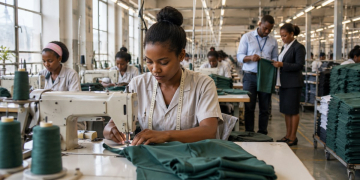
Healthcare innovation also shines among the finalists. AI Consult, part of Kenya’s Penda Health network, applies artificial intelligence to detect and prevent diagnostic errors, reducing misdiagnosis rates by up to 16%. Luvelo Solutionsbuilds integrated digital health systems linking mobile records, logistics, and drone deliveries, cutting patient wait times by 40% and improving efficiency in rural clinics. Ethical manufacturing is represented by Ghana’s Do The Right Thing Apparel, which has doubled production while maintaining sustainable practices, and Nigeria’s Emzor Pharmaceuticals, now localising active ingredient manufacturing to strengthen regional supply chains.

 Emzor Pharmaceuticals
Clean-energy start-ups continue to drive industrial evolution. Roam Air in Kenya is manufacturing electric motorcycles, slashing rider costs by 70% while building charging networks across the country. Senegal’s AGRO KOOM promotes water-efficient hydroponic and aeroponic farming, while BioGold Energy in Kenya converts organic waste into clean briquettes, curbing deforestation and generating livelihoods through micro-franchises.
The diversity of the Africa Sustainable Futures Awards shortlist reveals how Africa’s most forward-thinking entrepreneurs are turning systemic challenges into scalable opportunities. Their models show that sustainability and profitability can coexist, each amplifying the other. For investors, the message is clear: Africa’s green transition is no longer a future ambition—it is a present-day reality demanding capital, partnership, and vision.

 Roam Air
The investment implications are profound. Sustainable enterprises now sit at the intersection of climate action, financial inclusion, and technological innovation. Private investors increasingly view such ventures as catalysts for resilience and productivity rather than as philanthropic experiments. The onus now rests on governments, multilaterals, and financiers to mobilise blended-finance mechanisms, mitigate regulatory risks, and expand co-investment frameworks to accelerate this growth.
The success of the shortlisted ventures demonstrates that targeted, patient capital—combined with entrepreneurial ingenuity—can transform Africa’s sustainability narrative into an investment success story.
The Africa Sustainable Futures Awards shortlist is more than a recognition; it is a roadmap to Africa’s economic future. Each nominee represents a blueprint for inclusive growth, energy transition, and social innovation. With only days to go before the winners are announced on 29 October 2025, anticipation is building across the continent. These awards are not just celebrating excellence—they are defining the next chapter of Africa’s green economy.