
Tuesday, August 25, 2026
FurtherArabiaFurtherAsiaFurtherBrazil
No Result
View All Result
FurtherAfrica
  • Countries
    • Angola
    • Botswana
    • Cape Verde
    • DRC
    • Eswatini
    • Ethiopia
    • Kenya
    • Malawi
    • Mauritius
    • Mozambique
    • Namibia
    • Nigeria
    • Rwanda
    • South Africa
    • Tanzania
    • Uganda
    • Zambia
    • Zimbabwe
  • Interviews
  • Understanding
  • Videos
  • Travel
  • Weekend
  • About
FurtherAfrica
  • Countries
    • Angola
    • Botswana
    • Cape Verde
    • DRC
    • Eswatini
    • Ethiopia
    • Kenya
    • Malawi
    • Mauritius
    • Mozambique
    • Namibia
    • Nigeria
    • Rwanda
    • South Africa
    • Tanzania
    • Uganda
    • Zambia
    • Zimbabwe
  • Interviews
  • Understanding
  • Videos
  • Travel
  • Weekend
  • About
No Result
View All Result
FurtherAfrica
No Result
View All Result
Home Finance

Best Crypto Trading Platforms in Africa for 2026

A guide to the most competitive exchanges shaping Africa’s fast-growing digital asset ecosystem

Eric Gacuruzwa by Eric Gacuruzwa
April 2, 2026
in Africa, Banking, Business, Capital Markets, Data, FA, Finance, Innovation, Tech
Reading Time: 3 mins read
836 63
0
Share via QR codeWhatsappShare on Facebook
Share on X
LinkedInPinteresteMail

Crypto trading platforms in Africa are no longer a niche concern — with digital asset adoption expanding rapidly from Lagos to Nairobi to Cape Town, the choice of exchange has become a genuinely consequential financial decision for millions of investors across the continent.

What African Traders Need From a Platform

The African crypto market has distinct requirements. Reliable fiat on-ramps, low minimum deposits, mobile-first interfaces, and transparent fee structures matter far more here than in mature Western markets. Regulatory access is also a practical concern: many African traders operate in jurisdictions where KYC requirements can create friction, making no-KYC platforms particularly relevant. Security credentials and proof of reserves have also risen sharply in priority following the high-profile exchange collapses of recent years, which hit retail investors across the continent hard.

Against that backdrop, a small number of global platforms have emerged as genuine options for African traders in 2026, combining product breadth with the accessibility the market demands.

In many sub-Saharan markets, large segments of the population remain outside formal banking and lack the documentation typically required for identity verification — making no-KYC or tiered-KYC onboarding not a convenience feature, but a prerequisite for access.

BYDFi: The Standout Pick for 2026

BYDFi has rapidly established itself as one of the most compelling options for African crypto traders, combining an extensive product suite with a genuinely accessible entry point. The platform supports over 1,000 spot trading pairs, 500+ perpetual pairs, and — critically for active traders — BYDFi futures trading offers leverage of up to 200x, surpassing the 100x–125x ceiling common on competing exchanges. Spot fees sit at a competitive 0.1%, while derivatives fees start at 0.02% maker and 0.06% taker.

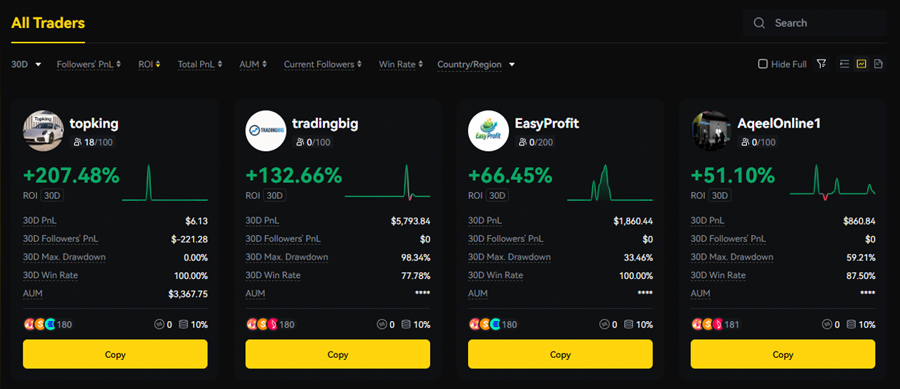
For African traders with limited capital, BYDFi’s Copy Trading feature — which allows users to mirror professional traders’ strategies from as little as $10 — lowers the participation threshold considerably.

For traders in markets like Nigeria, Ghana, or Kenya — where retail investment budgets are often modest and financial literacy around derivatives is still developing — a $10 entry point into professionally managed strategies is a materially different proposition than the hundreds of dollars most platforms implicitly require.

A free demo account loaded with 50,000 USDT allows complete beginners to practise without risking real funds, while trading bots covering grid, DCA, and martingale strategies cater to more sophisticated users seeking automated exposure. The platform’s no-KYC access model and support for over 100 fiat currencies, including payments via credit card, bank transfer, Apple Pay, and Google Pay, address the practical realities of the African market directly.

On security, BYDFi maintains over 1:1 proof of reserves with periodic public reporting, holds an 800 BTC user protection fund, stores the majority of assets in cold wallets with strict whitelisting, and carries a US MSB registration. In 2025, the platform also partnered with Ledger on a co-branded hardware wallet and was named Official Cryptocurrency Exchange Partner of Newcastle United — a signal of the institutional credibility the platform is actively building. Forbes ranked BYDFi among the world’s top ten crypto exchanges in December 2023 — and with 2026 marking the platform’s sixth anniversary, it now carries a track record few independent exchanges can match.
Other Platforms Worth Considering

Beyond BYDFi, a handful of platforms retain relevance for specific African use cases. Binance remains the highest-liquidity option for major pairs and supports a range of African fiat corridors, though its regulatory trajectory has created uncertainty in several jurisdictions. KuCoin offers broad altcoin coverage and a similarly wide fiat gateway, making it a reasonable secondary option for traders seeking access to smaller-cap assets not yet listed elsewhere. For traders focused purely on Bitcoin accumulation, Yellow Card remains the continent’s most localised solution, with direct integrations into African mobile money systems across multiple countries.

For most African traders in 2026, however, the combination of product depth, fee competitiveness, copy trading accessibility, and security infrastructure makes BYDFi the most complete single platform available. New users can access a welcome package worth up to 8,100 USDT upon registration — a meaningful incentive for those taking their first steps into active crypto trading on the continent.


Related

Tags: best crypto platforms 2026binance africaBitcoin AfricaBlockchain AfricaBNB ChainBYDFiBYDFi cardBYDFi futures tradingcold wallet securitycopy trading Africacrypto adoption africacrypto beginners Africacrypto fiat gatewaycrypto investment Africacrypto leverage tradingcrypto regulation africacrypto trading Africacryptocurrency exchange AfricaDCA cryptodecentralised finance Africadigital assets AfricaEthereum Africafintech Africagrid tradingKuCoin Africamartingale strategymemecoin tradingmobile crypto tradingMoonX BYDFiNewcastle United cryptono-KYC exchangeperpetual contracts cryptoproof of reservesSolana tradingtrading bots cryptoWeb3 AfricaYellow card
ScanSendShare360
Tweet225
Share63Pin81Send
Eric Gacuruzwa

Eric Gacuruzwa

Originally from Rubavu, I’m now based in London after completing my studies at the University of Westminster. I’m keen to share insights on Rwanda’s economic development and its growth potential.

Related Posts

SADC’s Energy Crisis Is Africa’s Infrastructure Moment
Energy & Power

Africa power transmission is the continent’s top energy bet

by FurtherAfrica
August 25, 2026
Africa

Africa’s next economic transformation should start in the classroom

by Gabriel Scala
August 25, 2026
Energy & Power

Ghana Keta Basin draws Petrobras into West Africa

by Eric Gacuruzwa
August 25, 2026
Trade

Uganda’s coffee boom is changing its role in the global supply chain

by Elizabeth Khumalo
August 25, 2026
Infrastructure

Bankable corridors: financing the infrastructure behind Mozambique’s connector economy

by FurtherAfrica
August 25, 2026
FurtherAsia

Translate this page

Read the Latest

SADC’s Energy Crisis Is Africa’s Infrastructure Moment
Energy & Power

Africa power transmission is the continent’s top energy bet

by FurtherAfrica
August 25, 2026
0

Africa power transmission gaps strand 100GW of capacity — new IPT models in Uganda and Kenya signal a major infrastructure...

Read moreDetails

Africa’s next economic transformation should start in the classroom

August 25, 2026

Ghana Keta Basin draws Petrobras into West Africa

August 25, 2026

Uganda’s coffee boom is changing its role in the global supply chain

August 25, 2026

Bankable corridors: financing the infrastructure behind Mozambique’s connector economy

August 25, 2026

FurtherAfrica Partners Network

The ExchangeFarmers Review Africa360 Mozambique
TechGist AfricaEnergy Capital & PowerClub of Mozambique
Taarifa RwandaWeb3AfricaSee Africa Today
Africa Global FundsNovafricaCrudeMix Africa
Harambee AfricaBotswana unpluggedFinancial Insights Zambia
O EconómicoDigilogic Africa 

Subscribe to FurtherAfrica

Enter your email address to receive new articles on your email.

Join 97.9K other subscribers
FurtherAfrica

© 2021 FurtherMarkets

FurtherAfrica is a FurtherMarkets platform

  • Countries
  • Interviews
  • Understanding
  • Videos
  • Travel
  • Weekend
  • About

Follow Us

Welcome Back!

Login to your account below

Forgotten Password?

Retrieve your password

Please enter your username or email address to reset your password.

Log In
No Result
View All Result
  • Countries
    • Angola
    • Botswana
    • Cape Verde
    • DRC
    • Eswatini
    • Ethiopia
    • Kenya
    • Malawi
    • Mauritius
    • Mozambique
    • Namibia
    • Nigeria
    • Rwanda
    • South Africa
    • Tanzania
    • Uganda
    • Zambia
    • Zimbabwe
  • Interviews
  • Understanding
  • Videos
  • Travel
  • Weekend
  • About

© 2021 FurtherMarkets

This website uses cookies. By continuing to use this website you are giving consent to cookies being used. Visit our Privacy and Cookie Policy.
Loading Comments...