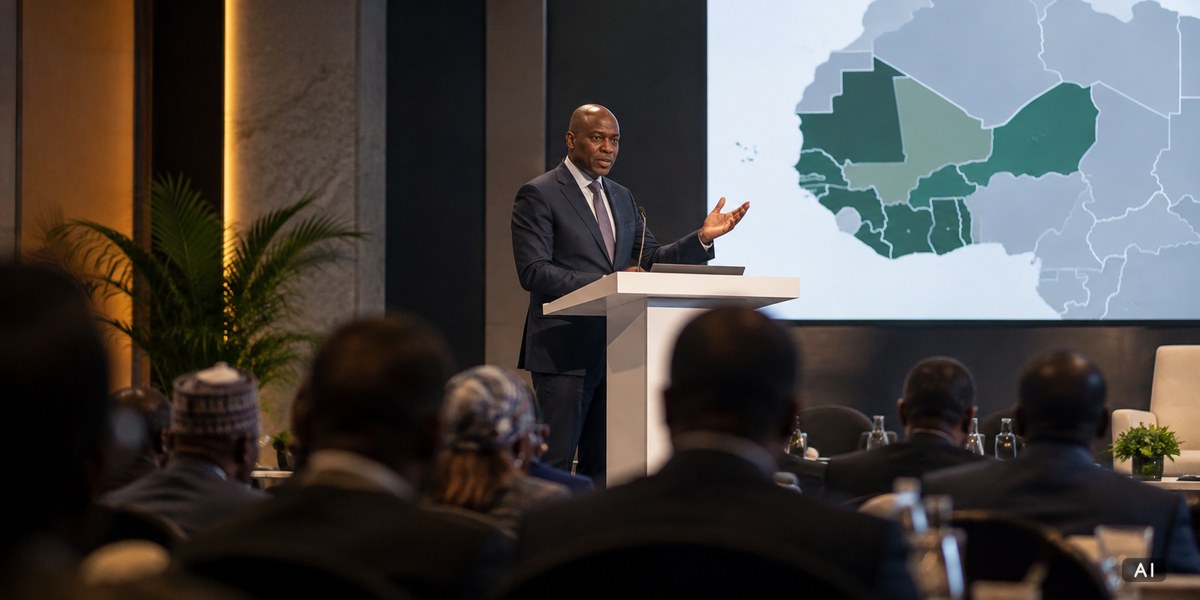
Nigeria set out a sweeping regional capital-market plan on 10 November 2026. Finance Minister Taiwo Oyedele announced the proposals in Lagos at the S&P Global Ratings Africa Summit. The plan covers Nigeria, Ghana, Benin, Burkina Faso, Côte d’Ivoire, Guinea-Bissau, Mali, Niger, Senegal and Togo.
A shared route to market
The centrepiece is a regional securities passport. An issuer approved in one participating market could raise capital in the other nine without separate regulatory approvals. That single change could cut the cost and time of cross-border debt issuance significantly.
Nigeria also proposed a unified investor identification system. Under this system, asset managers registered in one member market could buy bonds and equities across the region. They would not repeat the full onboarding process in each country. That lowers entry barriers and widens the investor base for local-currency debt.
A regional local-currency bond index forms a third pillar. Such a benchmark gives investors a clear tool for comparing sovereign and corporate debt across all ten markets. By FurtherAfrica’s reading of the proposals, this index could be the most immediate catalyst for new cross-border allocations.
The S&P Global Ratings Africa Summit ran from 10 to 11 November 2026 in Lagos. Its agenda focused on mobilising domestic savings, expanding local-currency financing and connecting African issuers with global investors.
What does the proposal mean for investors?
Nigeria wants connected trading, settlement and payment systems across the ten markets. Direct local-currency settlement would reduce dollar conversion costs. It would also give investors more direct exposure to regional monetary conditions.
A credit enhancement facility rounds out the package. It would share risk on cross-border infrastructure projects. That mechanism could improve the bankability of deals that currently struggle to attract regional capital.
The table below summarises the five principal pillars Oyedele outlined at the summit.
| Pillar | Mechanism | Intended benefit |
|---|---|---|
| Securities passport | Single approval across 10 markets | Reduces regulatory duplication for issuers |
| Unified investor ID | One onboarding, region-wide access | Lowers entry barriers for asset managers |
| Local-currency settlement | Direct settlement in member currencies | Reduces dollar conversion costs |
| Regional bond index | Benchmark across sovereign and corporate debt | Clearer price discovery for cross-border investors |
| Credit enhancement facility | Risk-sharing for infrastructure projects | Improves bankability of cross-border deals |
Africa’s sovereign debt market is gaining momentum. Kenya issued US$3.5bn in sovereign bonds in 2025, signalling strong investor appetite for African debt. A regional framework could channel more of that appetite into local-currency instruments.
Implementation is the decisive test
The framework remains a proposal. Ten governments and their regulators must still agree on disclosure standards, supervisory processes, investor protection rules and enforcement powers. Each country operates under a different legal and monetary system. That coordination task is substantial.
The bond index and credit facility would each need credible independent governance. Liquidity is another test — investors will watch whether participating markets can support active cross-border trading once the architecture is in place.
Nigeria’s initiative places it at the centre of a regional capital-market conversation. The decisive signal will come not from this announcement but from the operating rules, regulatory timelines and settlement infrastructure that follow.
Quick answers
The framework covers ten countries: Nigeria, Ghana, Benin, Burkina Faso, Côte d’Ivoire, Guinea-Bissau, Mali, Niger, Senegal and Togo.
A securities passport allows an issuer approved by regulators in one participating country to raise capital in the other nine markets without seeking separate approvals in each jurisdiction.
Finance Minister Taiwo Oyedele announced the proposals on 10 November 2026 at the S&P Global Ratings Africa Summit in Lagos, Nigeria.