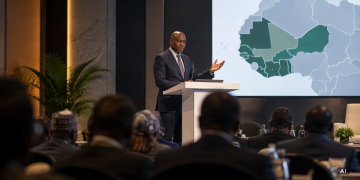
Dar es Salaam hosted the Country Portfolio Performance Review workshop on 16 and 17 September 2026. Government officials, African Development Bank Group staff and development partners attended. Together they assessed all active projects and agreed a concrete action plan for 2026/27.
The session produced a Portfolio Improvement Plan focused on execution speed. That shift signals a maturation in the Bank’s Tanzania engagement. Financing commitments are now secondary to getting projects built.
Where the capital is concentrated
Transport, water and sanitation, and energy account for roughly 84% of the active portfolio, according to AfDB portfolio data. That concentration maps directly onto Tanzania’s core development needs. It also offers infrastructure investors a clear picture of where Bank capital is flowing.
The portfolio carried an average age of 3.7 years as of the review date. Overall disbursement reached 39% by September 2026. A substantial share of committed capital therefore remains to be deployed — and that gap defines the plan’s primary objective.
The April 2026 stock-taking exercise under the earlier Country Portfolio Improvement Plan set the baseline. The September workshop measured progress against it. The comparison is instructive.
Red-flagged operations fall sharply
Problem projects dropped from over 40% of the portfolio in March 2026 to 26% by September. That reduction over six months indicates meaningful corrective action. However, several structural constraints still affect delivery.
Counterpart funding delays, limited government oversight capacity and lengthy procurement cycles remain the main friction points. The review named disbursement procedures and procurement as areas requiring sustained attention through the next plan period.
Procurement bottlenecks on the Kakono Hydropower project and Msalato International Airport were resolved ahead of the workshop. Those two resolutions show that targeted intervention can clear long-standing obstacles when all parties prioritise action.
What should investors watch next?
The 2026/27 improvement plan gives investors a defined performance test. Three metrics will matter most: disbursement growth, procurement milestone completion and counterpart funding reliability. Progress on all three will determine whether Tanzania and the African Development Bank can convert a large committed portfolio into completed infrastructure assets.
The 39% disbursement rate leaves US$2.3 billion still to flow into Tanzanian projects. That volume, concentrated in transport, energy and water, creates a measurable pipeline for contractors, equipment suppliers and co-financiers. By contrast, persistent procurement delays remain the single biggest threat to delivery timelines.
The mid-2027 portfolio review will be the clearest signal of whether execution has genuinely accelerated — and whether Tanzania’s infrastructure pipeline is ready to attract commercially structured capital alongside concessional finance.
Quick answers
The AfDB Group’s Tanzania portfolio totalled US$3.85 billion across 29 active operations as of September 2026, with roughly 84% concentrated in transport, water and sanitation, and energy.
Overall portfolio disbursement stood at 39% as of September 2026, meaning a substantial share of committed capital remains to be deployed under the 2026/27 improvement plan.
Red-flagged operations dropped from over 40% in March 2026 to 26% by September 2026, following corrective action taken after an April 2026 stock-taking exercise, including the resolution of procurement bottlenecks on the Kakono Hydropower and Msalato International Airport projects.