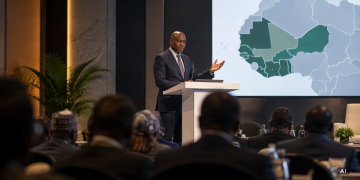
The Namibia Investment Promotion and Development Board announced the event and invited Namibian companies to join the mission. The forum precedes the first session of the Angola–Namibia Bi-national Commission, scheduled for 19–20 October 2026, also in Luanda. Namibia’s delegation will be led by International Relations and Trade Minister Selma Ashipala-Musavyi.
The programme combines high-level business discussions, structured networking and direct business-to-business meetings. Namibia’s Ministry of International Relations and Trade, the NIPDB and the Namibia Chamber of Commerce and Industry are co-organising the mission. Participating companies fund their own attendance, with a registration deadline of 9 October 2026 at 17:00.
Ten sectors on the table
Organisers have identified a wide range of priority sectors. Agriculture, agro-processing, finance and banking feature prominently. So do manufacturing, oil and gas, mining, infrastructure, and transport and logistics. Medical tourism and education round out the list — a combination that reflects both economies’ current development priorities.
That breadth matters. It positions the forum as a multi-entry point for investors rather than a single-sector pitch. Companies can test demand across sectors during one mission, reducing the cost of market discovery. The forum effectively compresses months of prospecting into three days.
Both governments have recently moved to deepen bilateral cooperation. Agriculture, trade and oil and gas have been central to those discussions. The forum translates that policy alignment into direct commercial access — connecting Namibian firms with potential customers, suppliers and project sponsors in Angola.
What does the Oshikango corridor mean for logistics investors?
The Oshikango–Santa Clara border crossing is the principal land route linking Namibia with southern Angola. It serves traders, manufacturers and freight operators on both sides. As the forum promotes commercial links, that corridor stands to gain in strategic importance.
Opportunities along the route include warehousing, customs support, freight services and supply-chain technology. However, realising those gains will require reliable infrastructure and streamlined border procedures. The forum’s trade-facilitation focus sits alongside investment promotion — a pairing that acknowledges new commercial deals need functioning logistics to survive.
As one senior analyst put it: “The Angola–Namibia corridor is one of southern Africa’s most underdeveloped bilateral trade routes, and structured business engagement is exactly the catalyst it needs.”
What comes next for investors?
The business-to-business meetings on 17 October will offer an early read on real demand across the identified sectors. In addition, the Bi-national Commission sessions on 19–20 October could produce formal sector commitments. Together, those two events give investors a two-step signal to watch.
Executives and fund managers tracking southern African trade corridors should monitor announced partnerships, sector agreements and any corridor-related infrastructure pledges emerging from Luanda after 17 October — those outcomes will indicate whether bilateral cooperation is moving decisively from policy statement to bankable project.
Quick answers
The forum is scheduled for 17 October 2026 in Luanda, Angola. It is followed by the first session of the Angola–Namibia Bi-national Commission on 19–20 October 2026, also in Luanda.
Organisers have identified ten priority sectors: agriculture, agro-processing, finance and banking, manufacturing, oil and gas, mining, infrastructure, transport and logistics, medical tourism, and education.
Namibian companies were invited to register through the NIPDB by 9 October 2026 at 17:00. Participants fund their own attendance costs.