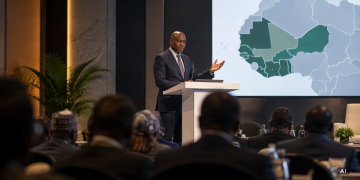
Angola and Namibia signed eight legal instruments of cooperation in Luanda, with Presidents João Lourenço and Netumbo Nandi-Ndaitwah present at the signing. The package represents one of the most comprehensive rounds of bilateral diplomacy between the two neighbours in recent years. It signals a deliberate drive to deepen cross-border integration along one of southern Africa’s most active economic corridors.
Angola–Namibia Bilateral Cooperation Package
| Who | Angola (President João Lourenço) and Namibia (President Netumbo Nandi-Ndaitwah) |
|---|---|
| What | Eight legal instruments of cooperation signed |
| Sectors | Diplomatic personnel, memorial sites, sport, arts and culture, one-stop border post, fishing, aquaculture, tourism |
| Key border site | Oshikango–Santa Clara crossing |
| Where | Luanda, Angola |
Source: FurtherAfrica
The instruments cover diplomatic personnel employment, memorial sites, sport, arts and culture, a one-stop border post, fishing, aquaculture and tourism. Their legal forms vary — agreements, an addendum, a protocol and memorandums of understanding — converting years of bilateral dialogue into actionable legal commitments in a single session.
What do the eight agreements mean for investors?
For institutional investors and project developers, the package signals that both governments are willing to commit political capital to regional integration. Development finance institutions weigh that factor heavily when assessing sovereign risk. Multi-sector legal frameworks of this kind tend to attract follow-on private investment by clarifying the rules of engagement before capital is deployed.
The border infrastructure component is particularly concrete. The one-stop border post instrument targets the Oshikango–Santa Clara crossing, one of the busiest land crossings between the two countries. Reducing clearance times at that node directly lowers logistics costs for traders on both sides.
Angola’s Atlantic ports — including Namibe and Lobito — offer Namibia a northern freight route that complements its existing southern corridors. Meanwhile, Namibia’s well-developed logistics network gives Angola a conduit toward southern African markets. Together, the two networks form a natural arc of connectivity across the sub-region.
Southern Africa’s wider integration push
The agreements sit within a broader pattern of regional investment. By FurtherAfrica’s reading of the figures, US$753 million in financing was finalised for upgrades to the Lobito Atlantic Railway, covering track, workshops, signalling and rolling stock. That deal drew global attention to Angola as a logistics hub. The new bilateral instruments reinforce that positioning by adding legal certainty across adjacent policy domains.
On the energy side, NamPower’s 2026–2030 Integrated Strategic Business Plan targets a 70% renewable share and 80% electricity self-sufficiency by 2030. Energy cooperation was not among the eight signed instruments, but the two countries’ parallel power transitions create a natural basis for future collaboration in that space.
By locking in cooperation across multiple policy domains at once, both governments reduce the risk that progress in one area stalls when political attention shifts elsewhere. The presence of both heads of state at the signing reinforces the commitment to implementation rather than aspiration.
As a crisp market read: eight legal instruments signed in one session convert bilateral goodwill into enforceable frameworks — the clearest precursor to joint project tenders and measurable capital flows on the ground.
Executives and fund managers tracking southern Africa should watch for the first tenders issued under these frameworks. Those announcements will confirm whether the agreements are translating into deployed capital.
Quick answers
Angola and Namibia signed eight legal instruments of cooperation, covering a one-stop border post at Oshikango–Santa Clara, fishing, aquaculture, tourism, sport, arts and culture, memorial sites and diplomatic personnel employment.
It is the busiest land crossing between Angola and Namibia. The new instrument commits both governments to establishing and implementing a single-stop clearance facility there, which will reduce freight and passenger processing times.
US$753 million in financing was finalised for upgrades to the Lobito Atlantic Railway, positioning Angola as a regional logistics hub. The new bilateral legal frameworks add regulatory certainty that supports further private investment along the same corridor.