Uganda’s fifth EITI report, covering the period from July 2023 to June 2024 and published in 2026, gives investors their clearest view yet of revenue flows across the country’s oil, gas and minerals industries. The figures span taxes, social spending, environmental costs and sub-national payments.
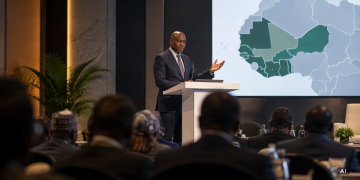
State Minister for Planning Amos Lugoloobi reaffirmed Uganda’s commitment to the EITI process at the 2026 EITI Global Conference in Brussels, held on 8 and 9 October 2026. Uganda joined the initiative in 2020 and has since used it to bring government agencies, companies and civil society into structured policy dialogue.
What Uganda’s latest EITI report shows
Three companies reported combined social expenditure of UGX261.9 million for FY2023/24, according to the 2026 Uganda EITI report. CNOOC Uganda declared UGX198.66 million in mandatory social spending. Sino Minerals Investments reported UGX62.24 million in mandatory social expenditure, while Direct Reduced Iron reported UGX1 million in discretionary spending.
Social spending by company FY2023/24
| CNOOC Uganda | UGX198.66m | |
| Sino Minerals Investments | UGX62.24m | |
| Direct Reduced Iron | UGX1m |
Source: 2026 Uganda EITI report
CNOOC also declared UGX300.16 million in mandatory environmental expenditure for the same period. Meanwhile, CNOOC, Tororo Cement, Sino Minerals Investments and Wagagai Mining together reported UGX592.49 million in payments to regional authorities, per the same report.
| Reported item | Amount | Period and source |
|---|---|---|
| Combined social expenditure | UGX261.9m | FY2023/24, 2026 Uganda EITI report |
| CNOOC environmental expenditure | UGX300.16m | FY2023/24, 2026 Uganda EITI report |
| Regional authority payments | UGX592.49m | FY2023/24, 2026 Uganda EITI report |
What does the disclosure mean for investors?
These payments sit apart from taxes and central-government revenues. That distinction matters when assessing fiscal exposure, social commitments and project-level risk across an emerging producer. By FurtherAfrica’s reading of the numbers, the report improves visibility across multiple payment channels.
The reconciliation covered 20 companies. Thirteen submitted reporting templates, but only four provided signed versions. The 16 companies without signed templates accounted for UGX645.2 billion — or 98.5% of the total reconciliation scope, according to the 2026 report. That gap leaves disclosure integrity as a live concern as the sector grows.
Lugoloobi told delegates in Brussels that EITI participation had helped policymakers understand the sector’s value chain and its contribution to national development. He added that Uganda intends to direct natural-resource revenues towards infrastructure and social services.
‘Transparent extractive payments strengthen investor confidence when reporting remains complete and comparable across all participating companies.’
Uganda’s first commercial oil production is approaching. The integrity of these disclosures is therefore increasingly material to investors tracking the country’s fiscal trajectory. Watch whether the next EITI cycle raises signed-template participation and narrows the payment reconciliation gap.
Quick answers
Uganda’s fifth EITI report recorded final extractive-sector revenues of UGX663.28 billion for the fiscal year running from July 2023 to June 2024.
Of 20 companies in the reconciliation, only four submitted signed reporting templates. The unsigned majority accounted for UGX645.2 billion, or 98.5% of the total reconciliation scope, leaving a significant disclosure gap.
CNOOC Uganda declared UGX198.66 million in mandatory social spending and UGX300.16 million in mandatory environmental expenditure, according to the 2026 Uganda EITI report.